


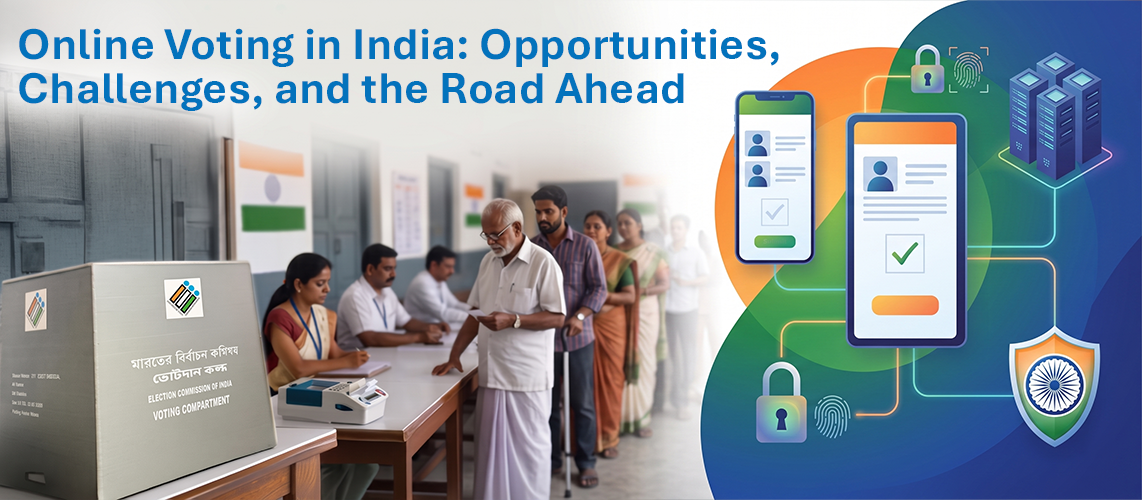
Free, fair, and credible elections are the cornerstones of every democracy. The integrity of elections defines the strength of democracy, and the way citizens cast their votes is central to that process. As digital technologies continue to transform governance worldwide, elections too are evolving beyond traditional polling booths, from paper ballots to electronic voting machines (EVMs) to online voting systems.
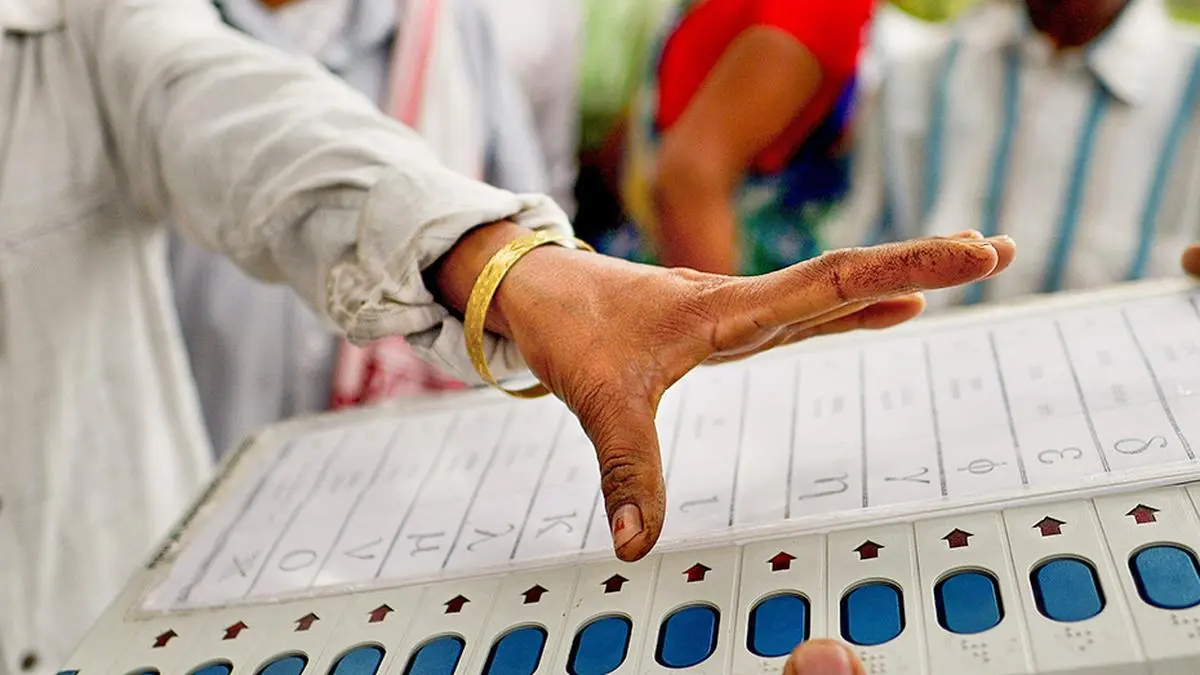
Since 1996, Brazil has adopted electronic voting machines (EVMs), which, in 2010, allowed for the results to be announced in under two hours after the final vote was cast, despite 135 million votes being cast.1 India has made use of EVMs since 2004, which are not connected to any networks as a safeguard measure.2 However, it is worth noting that EVMs are machines that can only be accessed through polling booths, while internet voting allows voters to cast their vote remotely and through their own devices.
Internet voting is a method of voting that allows voters to register their votes remotely using their own devices, by conducting the voting process on a platform such as an application. Typically, the option of internet voting is offered along with physical voting, giving voters a choice between voting digitally or physically.
In 2005, Estonia became the first country on the planet to allow its citizens to vote in its elections remotely, using the internet, which officials would deem a success. This prompted a revolution in elections, with 11 further elections being conducted through the internet since 2005.3 The 2023 Estonian Parliamentary Elections, won by the Reform Party, marked a landmark moment, as 51.1% of votes were cast digitally, making it the first election in history where over half of the voters cast their votes online.4 To register a vote digitally, voters would have to use their Estonian ID card and could register a digital vote four to six days before the day of the general election.5 The system made use of a closed-source programming model, ensuring that only the developers would have access to the code. This was done to ensure the safety of the platform on which users could vote.6

Given that India is the world’s largest democracy, the scale of the elections it conducts is incomparable to that of any other nation. For several NRIs* and inter-state migrants, participating in elections remains challenging. In this context, online voting in India has emerged as a potential alternative, but its adoption also brings in challenges. The question also connects with broader efforts to strengthen citizen participation and voter awareness, areas that B.PAC has worked on through its participatory democracy initiatives.
*NRI Stands for Non-Resident Indians. One can enrol as an Overseas Elector or NRI Voter if one is a citizen of India, absent from the country owing to employment, education, etc, and has not acquired citizenship of any other country and is otherwise eligible to be registered as a voter at the address mentioned in their passport. An overseas elector is not issued an EPIC & he/she will be allowed to vote in person at the polling station on production of the original passport. Source: Election Commission of India
The most common risk associated with online voting security is cybersecurity. India’s increasing exposure to cyber attacks against government institutions and infrastructure, like the 2022 cyber attack on AIIMS Delhi and the 2020 Mumbai Power Outage, reflects how fragile such propositions can be despite having tight security. Moreover, researchers from different countries, such as Australia in 2015, have discovered vulnerabilities in internet voting where votes could be altered or intercepted. Any person with hacking skills could easily manipulate the votes anytime, suggesting that for a democracy as large and politically diverse as India, even the thought of hacking undermines its election’s integrity.7 Nonetheless, even developing security infrastructure often requires large investments, such as in the case of Lithuania, which estimated that I-voting would cost approximately £20.7 million while its population was under 3 million. To think about it from the perspective of India, which has more than 970 million eligible voters, it would require enormous financial resources, which could otherwise be used for something that fetches advantages with not much risk in return.
8Another case of a technical glitch, which affected the 2021 state elections in New South Wales, Australia, prevented a significant number of voters from casting their votes. This sends an important lesson to India that even technically advanced nations fail to eliminate technical glitches, and given that India’s internet accessibility and digital literacy vary across states, such failures could either delay election results or completely ruin them, thereby pushing for a re-election with a whole new investment.
While the Gujarat State Election Commission has previously experimented with online voting, through the Municipal elections across six municipal corporations in Gujarat in 2011, this initiative failed as the voter registration process was complicated, leading to only 806 voters opting to vote digitally, out of 95.9 lakh eligible voters.9 Thus, it is imperative that any attempts to introduce online voting in India must consider user experience and make the online platform easily navigable and user-friendly, giving an incentive to voters to vote online.
Simultaneously, given India’s geopolitical implications, it has had experiences of cyber threats from hostile actors, and this may allow external regimes to influence India’s leadership. In this sense, an internet-based voting system could become a source of foreign intervention that could either crash the voting infrastructure or manipulate the entire election results, perhaps weaken the overall sovereignty, and make India vulnerable to external threats.
While internet voting may represent the future of some nations, for India, where the government’s legitimacy is determined by the elections, maintaining electoral confidence is just as important as maintaining efficiency and convenience.
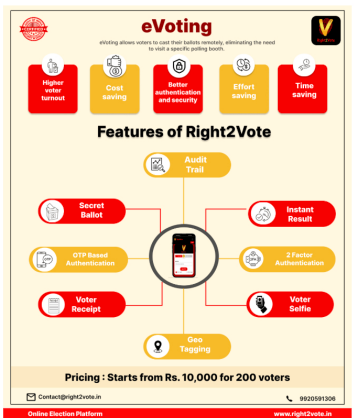
While the risks associated with internet voting for India remain valid, we cannot simply overlook the benefits that come with it. Military personnel, inter-state migrants, non-resident Indians, and differently abled persons, despite being eligible voters, often don’t get to exercise their suffrage rights because of the inconvenience of travelling all the way. Estonia was the first country to have successfully implemented internet voting, allowing those residing abroad to cast their vote digitally.10 Similarly, Switzerland makes an exemption for certain groups of people to exercise their voting rights digitally, while New South Wales, Australia, introduced an I-vote system for voters with disabilities. The efforts of such countries have pushed elections to become inclusive, efficient, and convenient. India can learn from such propositions too.11 According to the Ministry of External Affairs, India has around 37.28 million overseas Indians, and as per the 2011 Census, India has 26.8 million PWDs, who must travel to their registered constituency during elections, making voting expensive and inconvenient. B.PAC’s work on accessible elections also highlights the importance of reducing barriers to participation and making electoral processes more inclusive for different groups of voters. Given such challenges, internet voting may seem like a way forward, enabling inclusivity with millions of Indians getting to vote from wherever they are.
While we believe elections in India are held peacefully, incidents of electoral violence have been recorded in certain districts and states.12 During the 2024 General Elections in Manipur, armed men stormed various polling stations, threatening the voters and manually destroying the EVMs. Cases such as this create an environment of insecurity and danger, thereby negatively affecting voter turnout. Although the ECI deploys strong forces, the recorded incidents have instilled fear among the voters. Estonia’s experience reflects the pros of I-voting, where eligible voters need not be physically present if risks prevail or inconvenience occurs. However, in India, I-voting cannot entirely eradicate political violence, but it can certainly become an option for vulnerable voters.
A major criticism of I-voting, as posed by Lithuania, is its high implementation cost. While definitely an initial high investment, for India, an online voting system may become economical in the long run, given the fact that during every election, more than a million polling stations operate with many other logistical expenses; therefore, such implementation for specific categories of voters may reduce the overall expenses.
Tough periods, such as the pandemic that shook the entire world, propelling everyone to stay indoors, made physical presence impossible everywhere. During such a crisis, technology becomes the only way.13 Estonia’s I-voting stood the test of time when in the 2021 Municipal Election, around 2,73,620 voters cast their votes online. This accounted for nearly 54.7% of the total turnout, and while the percentage is less than half of the total population, it nevertheless suggests that during exigencies, this could prove an alternate way out. On the other hand, India’s Rajya Sabha Biennial Elections of 2020 could have avoided the situation if internet voting system had been made available. While the risks stand strong, the benefits could also increase the efficiency and convenience of the overall electoral process. Besides, India need not rush into implementing such systems; instead, it can learn from the experiences of countries like Estonia and Australia, and develop a secure, inclusive yet selective internet voting system in the near future.
In 2024, Lithuania’s Central Electoral Commission published a study in which it evaluated the feasibility of implementing online voting and published suggestions to make a hypothetical online voting system effective in the nation.14 These suggestions could also be applied to the Indian context if India were to adopt a similar voting system. The study recommends that voters should be able to change their votes for an unlimited number of times until the deadline to submit a vote has passed. This allows voters to change their vote if they had mistakenly chosen the wrong candidate or if they were under coercion when they first voted. Furthermore, the study recommends that e-voting in India should only complement physical voting, rather than fully replacing the latter. This would protect the integrity of elections. If the digital voting system gets compromised, voters can fall back on the physical voting system. Moreover, given how voters still place greater trust in physical voting systems, elections will appear legitimate to the wider public.
Aside from the study’s recommendations, it would be recommended to keep the platform used to vote open for days, rather than opening it only on the day of polling. This is to ensure that traffic is spread evenly throughout the days of voting, ensuring the platform does not crash as a result of too many online voters.
The future of online voting in India will undoubtedly be influenced by technology, but successful innovation requires careful preparation rather than haste. India has the opportunity to learn from international experiences, strengthen its digital infrastructure, and explore carefully designed initiatives. Ultimately, the objective should not simply be to modernise voting, but to ensure that every technological advancement reinforces the fairness, inclusivity, and legitimacy of the world’s largest democracy.
Want to see how B.PAC encourages voter awareness and participation? Read more about its Election Habba initiative.
By – Rohan Gopiram Menon, Priyanka Sunar, Suman M P
References
1. De Carvalho E, D. E. V. C. a. J. (2012, May 24). Dilma Rousseff é eleita presidente do Brasil. O Globo.
2. The Hindu Bureau. (2025, April 11). Indian EVMs not connected to Internet, Wi-Fi, says Election Commission amid Tulsi Gabbard’s comments. The Hindu.
3. BBC NEWS | Europe | Estonia forges ahead with e-vote. (n.d.). http://news.bbc.co.uk/2/hi/europe/4343374.stm
4. Mäeots, K. (2023, April 26). How did Estonia carry out the world’s first mostly online national elections – e-Estonia. e-Estonia. https://e-estonia.com/how-did-estonia-carry-out-the-worlds-first-mostly-online-national-elections/
5. BBC NEWS | Europe | Estonia forges ahead with e-vote. (n.d.). http://news.bbc.co.uk/2/hi/europe/4343374.stm
6. VILNIUS TECH. (2024, April 19). Internet voting in Lithuania: theoretically possible, but lacks public trust – VILNIUS TECH.https://vilniustech.lt/en/university/news/internet-voting-in-lithuania-theoretically-possible-but-lacks-public-trust-366406/
7. Civitta. (n.d.). Feasibility study for Lithuanian iVoting information system. https://civitta.com/our-work/feasibility-study-for-ivoting-information-system/
8. New South Wales Electoral Commission. (2025, January 22). Technology assisted voting (ivote) reports. https://elections.nsw.gov.au/about-us/reports/ivote-reports
9. Parmar, J. (2026, April 19). After over a decade and 40cr, e-voting fails to click in Gujarat. The Times of India.
10. Weber, A., & Taglioni, G. (2011). Swiss elections to the National Council: First trials with e-voting in elections at federal level. arXiv. https://arxiv.org/abs/1109.2489
11. Ministry of External Affairs. (n.d.). Population of overseas Indians. Government of India. https://www.mea.gov.in/population-of-overseas-indians
12. Achom, D., & Choudhury, R. (2024, April 19). Gunfire, EVMs destroyed, anger in crisis-hit Manipur amid chaotic voting. NDTV. https://www.ndtv.com/india-news/lok-sabha-elections-2024-gunfire-evms-destroyed-anger-in-crisis-hit-manipur-amid-chaotic-voting-5478201
13. National Electoral Committee of Estonia. (n.d.). Statistics about internet voting in Estonia. https://www.valimised.ee/en/archive/statistics-about-internet-voting-estonia
14. Central Electoral Commission of the Republic of Lithuania. (2024). FEASIBILITY STUDY FOR ONLINE VOTING INFORMATION SYSTEM. In IBIS Project.